
Needs are what every emotion is quietly about. This article looks at how core needs are understood in Emotion Focused Therapy, how to recognise them in the room, and why helping a client feel and voice an unmet need is one of the most important moves in the work.
On this page
- The Question That Lands Flat
- What Are Needs in Emotion Focused Therapy?
- Why Emotions and Needs Belong Together
- Needs vs. Wants, Wishes, and Demands
- Three Clinical Examples of Needs in EFT
- How to Recognise a Core Need in the Room
- What EFT Therapists Do With Unmet Needs
- Needs and the Four Emotion Types
- Frequently Asked Questions
- Key Takeaways: Needs in EFT
The Question That Lands Flat
Most therapists have asked it. The client has been describing a painful week, the therapist senses something important underneath, and asks: "What do you need?"
And the answer comes back: "I need to stop overthinking." Or "I need to be more confident." Or "I need him to just apologise."
None of these is wrong exactly. But none of them lands. The session stays where it was.
A moment later, the same client is talking about her sister's wedding, the seating plan, being placed at the far table. Her voice drops. She stops mid-sentence and says, almost to herself: "I just wanted someone to think of me."
That second sentence is a need. The first set of answers were goals and strategies. The difference between them is the subject of Card 06.
What Are Needs in Emotion Focused Therapy?
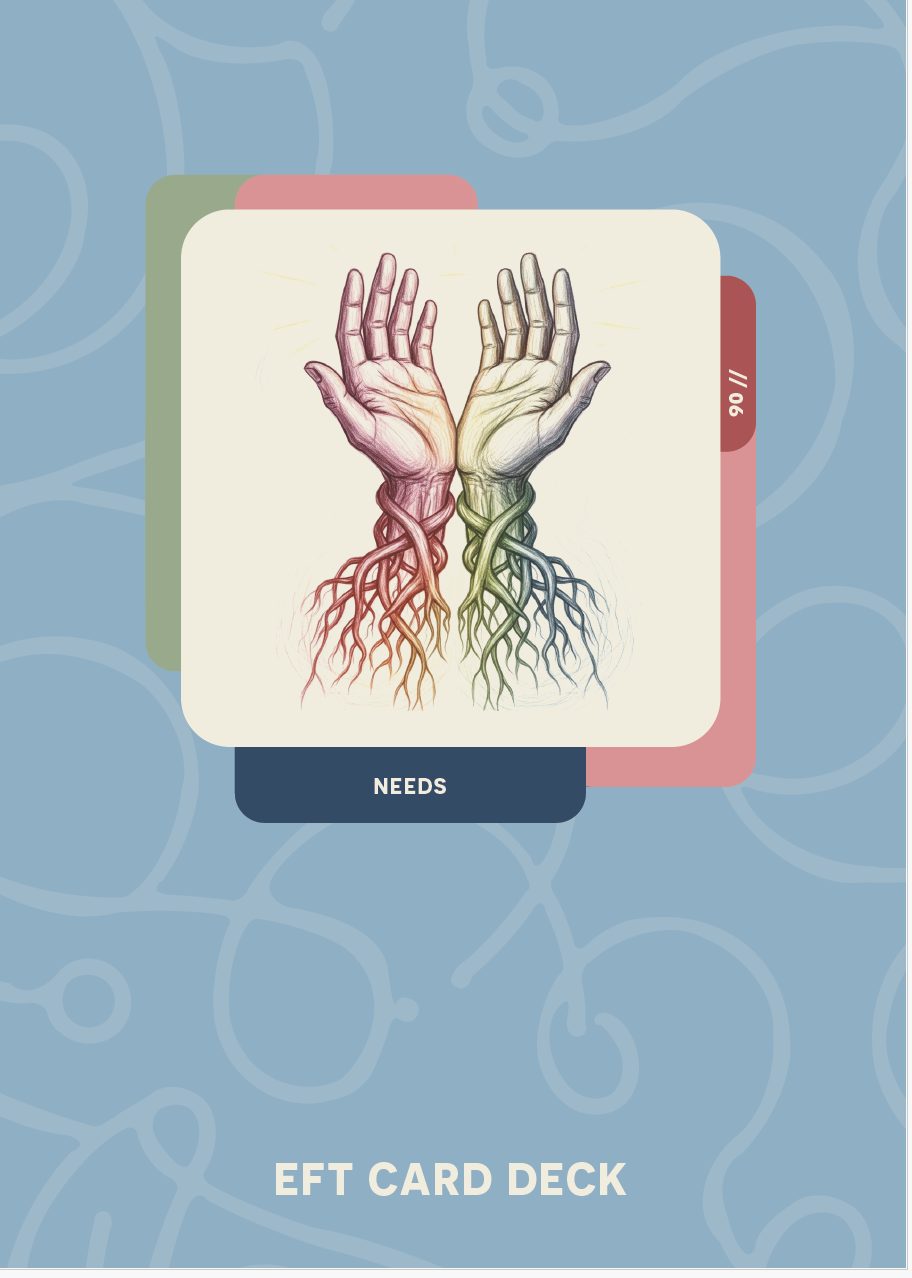
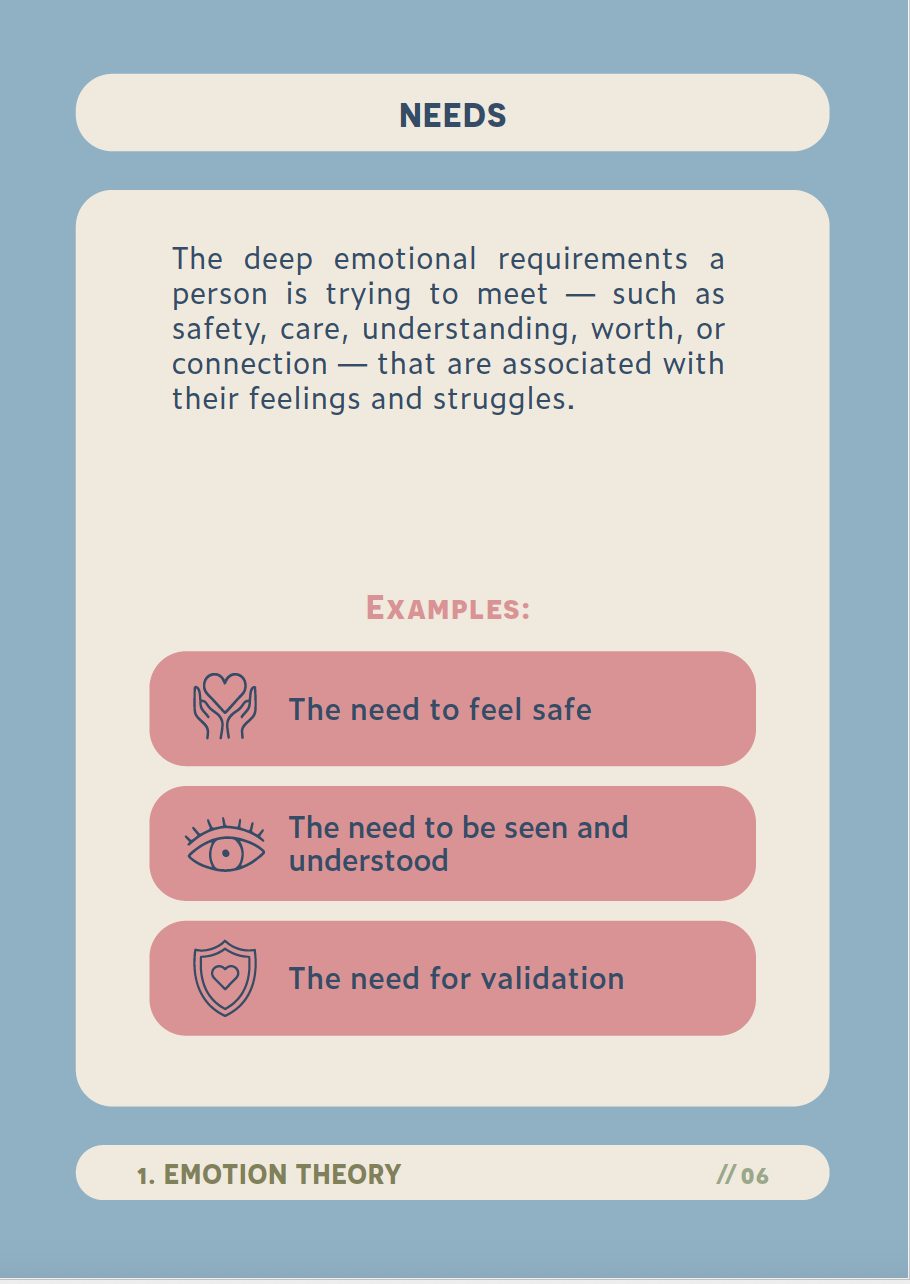
Card 06 of the EFT Clinical Process Card Deck defines needs as:
"The deep emotional requirements a person is trying to meet — such as safety, care, understanding, worth, or connection — that are associated with their feelings and struggles."
The card gives three examples: the need to feel safe, the need to be seen and understood, and the need for validation.
In Leslie Greenberg's Emotion Focused Therapy, needs are not an add-on to emotion theory. They sit at its centre. Emotions are understood as an adaptive system that constantly evaluates situations in relation to our needs, concerns, and goals. Fear tells us safety is threatened. Sadness tells us we have lost something or someone we needed. Anger tells us a boundary or entitlement has been violated. Shame tells us our standing or worth is at risk.
Greenberg often groups the most central human needs around attachment (closeness, connection, being cared for) and identity (being recognised, valued, validated as a separate self), with safety running underneath both. The card's three examples map cleanly onto this: safety, being seen and understood (attachment and identity), and validation (identity).
Why Emotions and Needs Belong Together
If emotions are signals about needs, then every painful emotion carries information about a need that was not met.
This is why EFT therapists do not simply help clients "feel their feelings." Feeling is necessary, but it is not the destination. When a client stays with a core painful emotion (see Card 02: Core Pain), what often emerges next is the need that the pain is organised around. The loneliness points to a need for connection. The shame points to a need to be accepted. The terror points to a need for protection.
Research on emotional processing in experiential therapy supports this sequence. Pascual-Leone and Greenberg's (2007) model of emotional processing describes clients moving from global distress, through fear, shame, or rejecting anger and the negative self-evaluations that come with them, to the articulation of an existential need. Reaching that need is the hinge point. From there, clients who resolve tend to move into assertive anger, self-soothing, and hurt or grief, and eventually into acceptance and agency.
In other words, the need is where the process turns. It is often the moment a client stops only suffering the pain and begins to stand for something in themselves.
Needs vs. Wants, Wishes, and Demands
One of the most practical distinctions in working with needs is telling a core need apart from things that sound similar.
A goal or strategy is about what the person thinks should happen: "I need to stop caring what people think." It is usually cognitive, future-oriented, and often turns against the self.
A demand is directed at another person's behaviour: "I need you to apologise." It locates the solution in the other, which leaves the client dependent on something they cannot control.
A core need is first-person, felt, and about the self's basic requirements: "I needed you to protect me." "I need to matter." It is usually spoken more quietly, and it tends to carry a sense of rightness when it is said aloud.
Demands and goals are not mistakes. They often contain a need folded inside them. Underneath "I need him to apologise" there may be "I need what happened to me to count." Part of the therapist's task is to help that inner layer surface.
Three Clinical Examples of Needs in EFT
The following are composite illustrations, not real clients.
1. The need to feel safe
A man in his forties describes flinching whenever his partner raises her voice, even in play. In unfinished business work with his father, he begins with a flat account of the shouting that filled his childhood home. As the therapist slows him down and he stays with the image of himself as a boy at the top of the stairs, fear rises, then a pause. "I needed home to be a place I wasn't scared in."
The therapist helps him say it directly to the imagined father. His voice firms. A few minutes later, anger arrives: "You were supposed to keep me safe, not be the thing I was scared of." The need has mobilised a protective, boundary-setting anger that was not available before.
2. The need to be seen and understood
A woman who grew up caring for a depressed mother is highly competent and describes herself as "not really a needs person." Her sessions are full of other people's problems. When the therapist gently reflects how little space there seems to be for her in her own story, she tears up. "Nobody ever asked how I was. I don't think anybody saw me."
Here the need is barely permitted. Saying it aloud evokes shame ("That sounds so self-pitying"). The therapist validates the need and its legitimacy before anything else. Over time, her sadness shifts from collapse into grief for what she missed, and eventually into a new capacity to let people close.
3. The need for validation
In a self-critical split, a client's critic tells him he is "too sensitive" and should "get over it." In the experiencing chair he initially agrees. As the critic's contempt is enacted more fully, the experiencing side starts to feel the sting. The therapist asks what he feels hearing this, then what he needs from that critical part. He says: "I need you to accept that it hurts. I'm not making it up."
This is the need for validation, voiced to the part of the self that has been withholding it. When the need is expressed with conviction, the critic often begins to soften, which is a central marker of resolution in two-chair work.
How to Recognise a Core Need in the Room
Needs tend to announce themselves through shifts in how the client is speaking, not only what they say. Look for:
- →A drop in voice and pace. Core needs rarely arrive at full speed. The client slows, softens, or pauses.
- →First-person language. "I needed," "I wanted," "I just want to matter," rather than "they should" or "people ought to."
- →A felt sense of rightness. The client may nod, exhale, or say "yes, that's it." The need fits.
- →A shift out of blame or complaint. The client moves from what the other did wrong to what they themselves longed for.
- →The appearance of shame or apology. Clients often apologise for needs as soon as they voice them. That reaction is itself a clue that something core has been touched.
Just as useful is recognising when you are not yet hearing a need: when the answer is fast, abstract, focused on changing oneself, or entirely about someone else's behaviour.
What EFT Therapists Do With Unmet Needs
Working with needs is difficult. That difficulty is inherent in the work itself: needs that went unmet early in life were often too painful, too dangerous, or too shaming to hold on to, so clients learned to stop feeling them. It is expected that they will not come easily.
Some principles that guide the work:
Follow the emotion to the need, not the other way round. Asking "what do you need?" before the core emotion is activated tends to produce intellectual answers. The same question, asked when the client is in contact with their pain, often opens something real.
Use empathic conjecture carefully. When a client is close but cannot find words, the therapist can offer a tentative reflection: "And somewhere in there, maybe what you needed so badly was just for someone to notice." The client's felt response is the test. If it does not fit, let it go.
Invite the need to be expressed, not just described. In chairwork, a need spoken to the imagined other or to the critic carries more experiential weight than one described to the therapist. The goal is expression with conviction.
Support the client's sense of entitlement to the need. The transformative step is not simply naming the need. It is the client coming to feel that the need was, and is, legitimate. That shift in self-organisation is what allows new emotion to emerge.
Watch what the need mobilises. A validated need typically draws new adaptive emotion: assertive anger at violation, grief at loss, compassion toward the self. This is how one emotion changes another, the process described in Card 01: Transformation by Synthesis.
Do not rush to meet the need. It can be tempting to reassure, fix, or problem-solve once a need is voiced. In EFT, the change comes from the client accessing and owning the need, not from the therapist or the other person finally meeting it. The past need will not be met by the person who failed it. What changes is how the client stands in relation to it.
Needs and the Four Emotion Types
Needs connect directly to the emotion types covered earlier in the series:
- →Primary adaptive emotions point directly and accurately toward a need in the present situation.
- →Primary maladaptive emotions carry an old unmet need, often frozen in the shame or fear of the original experience.
- →Secondary emotions can obscure the need, such as when anger covers a need for comfort.
- →Instrumental emotions try to get a need met indirectly, through the effect the emotion has on others.
Seen this way, much of EFT's emotion assessment is a search for the need. Which emotion is primary? And what is it trying to protect, reach for, or recover?
For a closer look at telling these emotion types apart in practice, see Primary vs Secondary Emotions in EFT and How EFT Therapists Choose Which Emotion to Work With First.
Frequently Asked Questions
What are needs in Emotion Focused Therapy?
In EFT, needs are the basic emotional requirements that emotions are organised around, such as safety, connection, being understood, and worth. Emotions signal whether these needs are being met or threatened.
Why do EFT therapists ask about unmet needs?
Because accessing the unmet need inside a painful emotion is often the turning point in emotional change. Once a client feels the need and its legitimacy, new adaptive emotions such as assertive anger or grief can emerge and transform the old painful state.
Is expressing a need in therapy the same as getting it met?
No. In EFT, the change does not depend on the need being met by another person. It comes from the client accessing the need, voicing it, and coming to feel entitled to it. That internal shift changes how the self is organised.
What if a client says they don't have any needs?
This is common, especially for clients whose needs were ignored or punished early on. The absence of needs is usually a learned protection rather than a true absence. The work is to go slowly, attend to the shame or fear that arises around needing, and validate the need when it begins to appear.
How is this different from needs in Emotionally Focused Therapy for couples?
Sue Johnson's Emotionally Focused Therapy also works with attachment needs, but within an attachment-theory framework focused on the couple bond. Leslie Greenberg's Emotion Focused Therapy works with a broader range of needs, including identity and validation needs, and places them within a model of emotion schemes and emotional change. For more, see Emotion Focused Therapy vs Emotionally Focused Therapy.
Key Takeaways: Needs in EFT
- →Needs are the deep emotional requirements that emotions are organised around: safety, being seen and understood, validation, connection, worth.
- →Every painful emotion carries information about an unmet need.
- →A core need is first-person, felt, and about the self. Goals, strategies, and demands on others often contain a need, but are not yet the need itself.
- →Needs are best accessed when core emotion is activated, not asked for in the abstract.
- →The change comes from the client feeling and asserting the legitimacy of the need, which mobilises new adaptive emotion.
- →Difficulty accessing needs is expected. Needs that went unmet were often pushed away for good reason.
Using Card 06 in Practice
Card 06 sits in the Emotion Theory section of the EFT Clinical Process Card Deck. It works well as a reminder mid-session, when a client's pain is present and you are listening for what it is reaching toward. It is also useful in supervision and case conceptualisation: for any client, ask which of the core needs has been most consistently unmet, and how their emotions are organised around protecting or pursuing it.
References
- →Greenberg, L. S. (2015). Emotion-Focused Therapy: Coaching Clients to Work Through Their Feelings (2nd ed.). American Psychological Association.
- →Greenberg, L. S., & Paivio, S. C. (1997). Working With Emotions in Psychotherapy. Guilford Press.
- →Pascual-Leone, A., & Greenberg, L. S. (2007). Emotional processing in experiential therapy: Why "the only way out is through." Journal of Consulting and Clinical Psychology, 75(6), 875–887.
Related clinical articles
- →Card 01: Transformation by Synthesis in EFT
- →Card 02: Core Pain in Emotion Focused Therapy
- →Card 03: Primary Maladaptive Emotion in EFT
- →Card 04: Secondary Emotion in EFT
- →Card 05: Instrumental Emotions in EFT
- →Unfinished Business in Emotion Focused Therapy
About the Author
Aaron Lerch
Clinical Psychologist · Certified Emotion Focused Therapist · Certified EFT Supervisor and Trainer, ISEFT Level D
Written by Aaron Lerch, Clinical Psychologist, Certified Emotion Focused Therapist, Certified EFT Supervisor, Trainer, and founder of EFTSkills.
Aaron's clinical and teaching work focuses on helping therapists apply Emotion Focused Therapy with greater precision in real sessions — including marker recognition, emotional process tracking, chair work, core pain, and task selection.