
Part of the EFTSkills guide to Emotion Focused Therapy.
Understanding the difference between primary and secondary emotions in Emotion Focused Therapy (EFT) is not a minor technical detail. It is one of the central clinical discriminations that determines whether therapy deepens, stalls, or transforms.
Many therapy sessions stall not because emotion is absent, but because the therapist is working with secondary emotion as if it were primary.
The client looks emotional. Their voice is strong. Their body is activated. There may be tears or anger. Yet nothing reorganises. The same cycles repeat. The same complaints resurface.
In EFT, the key question is not simply "Is there emotion?" but rather:
Is this the primary emotion, or a reaction to something deeper?
This article clarifies:
- What primary emotion means in EFT
- What secondary emotion is and how it functions
- The difference between primary adaptive and primary maladaptive emotion
- How to identify primary vs secondary emotions in therapy sessions
- Why this distinction directly affects intervention and outcome
Why the Difference Between Primary and Secondary Emotions Matters More Than It Seems
If you do not differentiate primary and secondary emotions in therapy, you risk:
- Deepening defensive emotion
- Validating reactive anger without accessing hurt
- Reinforcing maladaptive shame
- Missing transformation opportunities
Therapists often mistake emotional intensity for emotional depth. But in EFT, depth is defined by contact with core meaning and adaptive action tendency, not volume.
Secondary emotions are often louder. Primary emotions are often more vulnerable.
When this distinction is missed, therapy becomes circular. When it is recognised, sessions begin to move.
What Is a Primary Emotion in Emotion Focused Therapy?
In Emotion Focused Therapy, a primary emotion is the client's first, direct, immediate response to a situation.
It arises automatically. It carries core meaning. It prepares the organism for action.
Primary emotion has four defining features:
- It is biologically grounded.
- It conveys information about need, threat, or value.
- It has a clear action tendency.
- When accessed fully, it reorganises experience.
Primary emotions can be either adaptive or maladaptive.
Understanding this distinction is central to effective EFT intervention.
Primary Adaptive Emotion in EFT
Primary adaptive emotion is a direct, healthy response to present circumstances. It fits the situation.
When processed fully, it moves the client toward effective action.
Examples of primary adaptive emotions in therapy include:
Assertive Anger
A client feels angry when their boundaries are violated. The anger clarifies: "This is not acceptable." The action tendency is protective and boundary-setting.
When deepened, the anger becomes organised and grounded rather than explosive.
Grief
A client mourns a real loss. Sadness signals the need for comfort and integration. When allowed, grief softens defenses and supports adaptation.
Fear in Real Danger
Fear in response to actual threat mobilises protective behaviour. It sharpens attention and prepares escape or caution.
Primary adaptive emotion tends to deepen when explored. It becomes more specific. Meaning becomes clearer. Clients move from global statements to precise experience.
If the emotion clarifies and organises the client's experience, it is likely primary and adaptive.
The therapeutic task here is deepening and consolidation.
Primary Maladaptive Emotion in EFT
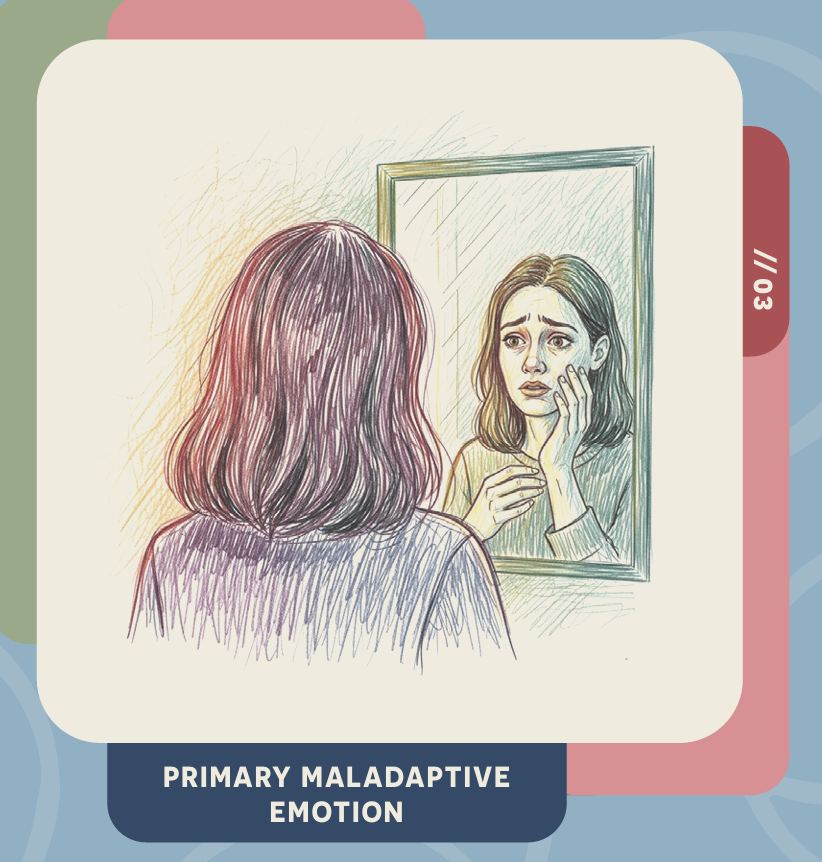
From the EFTSkills Clinical Process Card Deck
Primary emotion can also be immediate and automatic yet based on past learning rather than present reality. This is called primary maladaptive emotion.
It feels current. But it is organised around old emotional schemes.
Common examples include:
Chronic Shame
A client feels fundamentally defective in response to minor relational tension. The shame is immediate and global: "I am bad."
Trauma-Based Fear
The body reacts as if danger is present when no objective threat exists. The emotional system is responding to historical memory.
Worthlessness
The client collapses into self-criticism and self-negation automatically, even in neutral interactions.
These emotions are primary in timing but maladaptive in structure.
If deepened without transformation, they can strengthen entrenched patterns.
The therapeutic task here is transformation, often by activating competing adaptive emotion.
This is discussed further in the related article on Transforming Maladaptive Emotion in EFT.
What Is a Secondary Emotion in EFT?

From the EFTSkills Clinical Process Card Deck
A secondary emotion is an emotional reaction to another emotion.
It is not the first response. It develops in response to the first response.
For example:
- Anger covering hurt
- Anxiety covering grief
- Numbness covering fear
- Indifference covering shame
Secondary emotions often serve a regulatory function. They protect the client from experiencing something more vulnerable or disorganising.
They are frequently louder, more cognitively elaborated, and more rehearsed.
This is why therapists often mistake secondary emotion for primary emotion.
But secondary emotion tends to:
- Repeat without deepening
- Escalate without clarifying
- Remain global rather than specific
Volume is not depth.
If emotion intensifies but meaning does not clarify, consider that it may be secondary.
Primary vs Secondary Emotions: A Simple Video Explanation
The distinction between primary and secondary emotions is central in Emotion-Focused Therapy. Primary emotions are the more direct emotional responses, while secondary emotions are reactions to those first emotions. This short video gives a simple explanation of how one emotion can sit underneath another, and why therapists need to listen for the deeper emotional response beneath the surface reaction.
To apply this distinction clinically, continue with EFTSkills guides on emotional markers, core pain, two-chair dialogue, and empty-chair work.
How to Identify Primary vs Secondary Emotions in Therapy Sessions
Learning how to recognise primary and secondary emotions in session is one of the most important clinical skills in EFT.
This discrimination is process-based, not conceptual.
1. Tone Shifts
When primary emotion emerges, tone often changes.
Les Greenberg has often told me how the voice is the main characteristic to look out for. The voice may soften, slow, or tremble. Language becomes simpler. The client moves from explanation to immediate experience.
Secondary emotion often sounds consistent and rehearsed. It may feel rigid or argumentative.
2. Body Changes
Primary emotion is accompanied by visible physiological reorganisation. Breath shifts. Shoulders drop. Eyes moisten.
Secondary emotion often looks defended. The body leans forward in attack or tightens in anxiety.
3. Repetition vs Deepening
Secondary emotion circles.
Clients repeat grievances with increasing intensity but no added specificity.
Primary emotion deepens.
A client moves from "I'm angry" to "When he laughed, I felt small and exposed." Specific event. Specific meaning.
4. Global Intensity vs Specific Meaning
Secondary emotion may be globally intense but vague.
Primary emotion becomes more precise and connected to need.
Micro-Vignette 1: Anger Covering Hurt
A client says, loudly, "I'm furious. She never listens."
The anger escalates as she lists grievances. Nothing shifts.
The therapist slows the process and asks, "When she turned away, what happened inside?"
Her voice drops. "It felt humiliating. Like I didn't matter."
Tears emerge.
The anger was secondary. The humiliation was primary.
Micro-Vignette 2: Anxiety Covering Grief
A man reports constant anxiety about job performance.
When asked what losing the job would mean, he swallows. "It would mean I disappointed my father again."
The anxiety was protecting against grief and longing.
Micro-Vignette 3: "I Don't Care" Covering Hurt
A client says, flatly, "I don't care what they think."
When invited to notice bodily sensation, he pauses. "Actually… it stings."
The indifference was secondary. The hurt was primary.
A Practical Question to Anchor the Distinction in Session
When working in EFT, one question consistently sharpens the difference between primary and secondary emotions:
"If we stay with this feeling, does it become clearer — or louder?"
Primary emotion becomes clearer.
Secondary emotion becomes louder.
When you stay with primary adaptive emotion, clients typically move toward increased specificity. The experience differentiates. Meaning emerges. There is often softening, even when the emotion is painful.
When you stay with secondary emotion, escalation often replaces clarification. The client may intensify their tone, repeat the same narrative, or broaden the emotional field: "It's always like this." "Everything feels wrong." The experience expands but does not deepen.
Another useful clinical test is this:
Does this emotion organise the client toward need, or away from vulnerability?
Primary adaptive emotion moves toward need. Secondary emotion often moves away from it.
Anger that clarifies a boundary is organising. Anger that avoids humiliation is protective.
Anxiety that signals real threat is organising. Anxiety that blocks grief is protective.
This distinction is subtle but operational. It helps answer a crucial question in Emotion Focused Therapy:
Are we deepening core experience, or reinforcing a defensive cycle?
Therapists who consistently ask this in-session question develop sharper emotional discrimination. Over time, it becomes intuitive. The work becomes less about chasing intensity and more about tracking organisation.
That shift alone often changes therapeutic momentum.
Common Therapist Errors When Working With Secondary Emotion
Several predictable mistakes occur when the difference between primary and secondary emotions is not recognised.
Mistaking Intensity for Depth
Strong anger or panic may be assumed to be core. But secondary emotion can be intense without being transformative.
Validating Secondary Anger Without Differentiation
Empathic validation is essential in EFT. But if you validate defensive anger without exploring what it protects, you stabilise the defense.
Confronting Too Quickly
Labeling anger as "covering hurt" prematurely can shame clients. Differentiation must emerge experientially.
Colluding With Narrative Instead of Felt Sense
Secondary emotion often comes with a detailed story. If the therapist stays in narrative rather than guiding inward attention, primary emotion remains inaccessible.
These errors slow progress and reduce therapeutic impact.
Task Implications in EFT: Why This Distinction Changes Intervention
Differentiating primary and secondary emotions directly determines intervention strategy.
- Primary adaptive emotion → Deepen and consolidate
- Secondary emotion → Differentiate and access underlying feeling
- Primary maladaptive emotion → Transform through competing adaptive emotion
- Primary adaptive emotion (after access) → Support integration and action
Without this clarity, therapists risk applying the wrong task at the wrong moment.
This precision connects directly with emotional markers described in the earlier article on Emotional Markers in EFT. Accurate emotional discrimination sharpens marker recognition and improves task selection.
It also aligns with the discussion in Depth of Emotional Processing in EFT, where intensity alone is shown to be insufficient for transformation.
Why the Primary vs Secondary Emotion Distinction Predicts Outcome
Research in Emotion Focused Therapy consistently demonstrates that accessing primary adaptive emotion predicts therapeutic change.
Leslie Greenberg's work has repeatedly shown that transformation occurs when clients contact core adaptive emotion rather than remaining in reactive states.
Studies by Pascual-Leone further highlight that moving from secondary reactive emotion into primary adaptive experience is associated with structural change in emotional schemes.
The mechanism is not catharsis.
It is reorganisation.
When clients access primary adaptive emotion, new meaning emerges. New action tendencies become available. Emotional schemes reorganise.
If therapy remains at the level of secondary emotion, insight may increase, but structural transformation is limited.
Frequently Asked Questions
What is the difference between primary and secondary emotions in EFT?
Primary emotions are the first, direct response to a situation and carry core meaning and action tendency. Secondary emotions are reactions to those primary emotions and often function defensively.
Are secondary emotions real emotions?
Yes. Secondary emotions are real and often intense. However, they are reactions to underlying feelings and may not lead to adaptive reorganisation unless differentiated.
How can therapists tell if an emotion is primary?
Primary emotions deepen, clarify meaning, and connect to specific needs. Secondary emotions tend to repeat, escalate, and remain global without increasing specificity.
Integrating This With the Broader EFT Framework
This distinction between primary and secondary emotion does not stand alone. It operates within the wider architecture of EFT process diagnosis.
In the earlier article on Emotional Markers in EFT, we outlined how markers signal readiness for specific tasks. Emotional discrimination sharpens that recognition. When a therapist can identify whether anger is secondary or primary adaptive, the marker becomes clearer and task selection becomes more precise.
Similarly, in the article on Depth of Emotional Processing, we explored the difference between emotional intensity and emotional transformation. The primary–secondary distinction is one of the mechanisms behind that difference. Secondary emotion can be intense without being transformative. Primary adaptive emotion, even when quieter, reorganises meaning.
You may also notice how this connects to the framework discussed in Transforming Maladaptive Emotion. Primary maladaptive states require activation of competing adaptive emotion. Without differentiating maladaptive shame from secondary frustration, that transformation task cannot be implemented accurately.
Across these articles, the unifying principle is process precision. EFT is not simply about helping clients "feel more." It is about identifying which emotional state is organising the client's experience in this moment and intervening accordingly.
The therapist's skill lies in that discrimination.
Final Integration: The Discipline of Emotional Discrimination
Distinguishing primary from secondary emotion in EFT is a clinical discipline.
It requires slowing down. It requires resisting the pull of loud emotion. It requires sustained attention to tone, body, and meaning.
Emotional depth is not defined by how much is felt.
It is defined by what is being felt, and whether that emotion moves the client toward adaptive action.
When therapists refine their ability to identify primary versus secondary emotions, sessions become less circular. Interventions become more precise. Emotional processing becomes transformative rather than repetitive.
In Emotion Focused Therapy, progress often depends not on intensifying emotion, but on clarifying it.
And that clarification begins with a simple question:
Is this the first emotion, or a reaction to something deeper?
Discussion Questions
What cues help you distinguish primary from secondary emotion in your sessions?
Where do you most often find yourself mistaking intensity for depth?
How has differentiating secondary anger changed your intervention choices?
— Aaron Lerch
This article is part of the EFTSkills Clinical Foundations series — grounding clinical practice in the core distinctions of Emotion Focused Therapy.
Stay Updated on EFTSkills
If you would like to be notified when the EFTSkills Clinical Process Card Deck becomes available — and receive occasional clinical articles on emotional markers and clinical process in Emotion Focused Therapy — you can join the EFTSkills mailing list.