Part of the EFTSkills guide to Emotion Focused Therapy.
Advanced clinical reflection for EFT therapists and supervisors.
Focus: Marker precision and attachment injury transformation in unfinished business work.
In Emotion Focused Therapy (EFT), the unfinished business task is often introduced in a clean, teachable way: when a client carries unresolved emotional pain toward a significant other, we facilitate a dialogue with that internalised other using an empty chair.
Conceptually, this is straightforward.
Clinically, it is rarely that simple.
"Unfinished business" is not merely about expressing anger toward a parent. It is about transforming maladaptive emotional responses organised around attachment injury—responses that were adaptive at the time, but remain active and organising in the present. In complex trauma presentations, unfinished business is frequently present but often obscured by minimisation, emotional overcontrol, dissociation, secondary anger, or chronic relational strategies that keep vulnerability at a distance.
This article focuses on marker precision, task differentiation, and the emotional sequence of transformation—so that unfinished business work reliably produces reorganisation, not simply discharge.
1) What Defines Unfinished Business
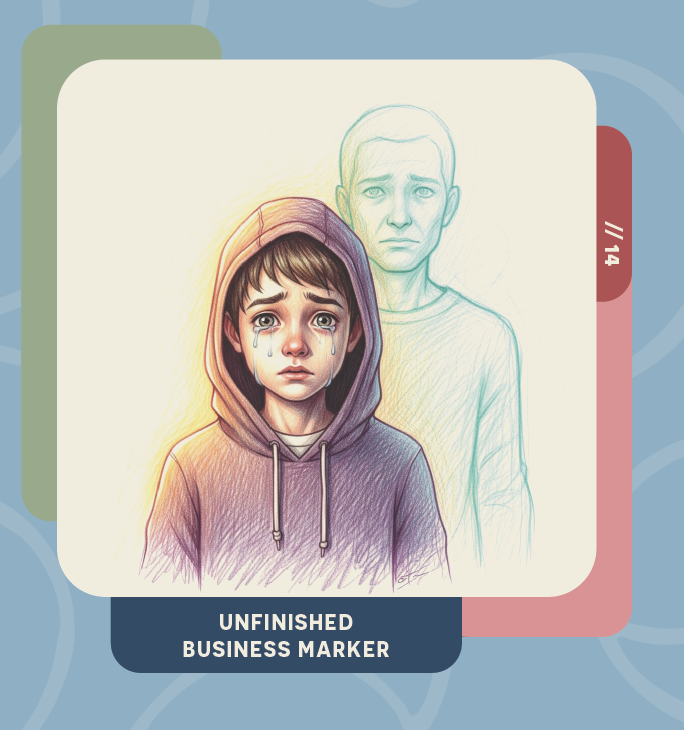
From the EFTSkills Clinical Process Card Deck
The Unfinished Business Marker appears when unresolved emotional pain toward an important attachment figure remains active in the present.
The marker is not simply a complaint or a narrative:
- "I'm still angry at my mother."
- "My father ruined my childhood."
- "I can't forgive what happened."
Those statements may be present, but they do not define the marker.
A clinically useful definition of unfinished business includes three elements:
- An internalised attachment figure who remains emotionally powerful (the client's responding is still organised around this person).
- Persistent emotional activation when the relationship is contacted (often via memory, imagery, or in-session evocation).
- A felt sense that something essential remains unresolved—something not said, not received, not recognised, not protected, not repaired.
Typical emotional tones include:
- Secondary anger/resentment that protects against vulnerability
- Primary hurt (pain of rejection, humiliation, neglect)
- Longing (for comfort, recognition, protection, attunement)
- Shame (self-blame, defectiveness, "I wasn't worth it")
- Grief (for what was never received; for lost possibilities)
- Fear of closeness (attachment as unsafe)
Unfinished business is, at its core, attachment injury work: the client is still emotionally organised by an unrepaired relational wound.
2) Common Clinical Drifts
Drift 1: Treating Narrative Rumination as the Marker
A client repeatedly tells the story, sometimes in detail and with coherence. The therapist assumes unfinished business and moves to chair work.
But repetition is not the marker.
The key question is: Is the emotional organisation alive now? If the client is describing events without present emotional contact—without a somatic shift, affective change, or emergent need—then evocative unfolding (or empathic exploration) may be indicated first. Unfinished business is not "about the past." It is about the past still organising the present.
Clinical check: When the client speaks about the person, do you see a shift in breath, face, posture, or voice? Does affect come online? Does something "tighten," "drop," or "flood"? If not, chair work may be premature.
Drift 2: Moving to Cathartic Anger Without Accessing Primary Emotion
Unfinished business work can devolve into strong anger expression that feels energetic and productive, but does not transform the underlying injury.
Anger has an important place—especially adaptive anger that restores dignity and boundaries. But when anger stays global, repetitive, or performative, it often functions as protection against the deeper attachment pain.
Transformation typically requires a shift from:
- Secondary anger → primary hurt/longing → need → grief → adaptive self-protection/self-validation
Drift 3: Avoiding the Task Because the Injury Is "Too Big"
With complex trauma, injuries are often chronic: emotional neglect, subtle humiliation, repeated absence. Therapists can hesitate—especially when the client has limited affect tolerance or strong protective control.
Avoidance is understandable, but it often leaves the client stuck in an overregulated life: functional, reflective, and unchanged.
The answer is not to avoid the task—it is to pace it:
- build safety,
- track tolerance,
- titrate emotional contact,
- and proceed in small, precise steps.
Unfinished business in complex trauma often begins quietly. Steadiness matters more than intensity.
3) Micro-Transcript: A Subtle Marker
Client: I know my mother did the best she could. She was overwhelmed. I understand that.
Therapist: As you say you understand, what happens inside right now?
Client: (pause) My chest feels tight.
Therapist: Stay with the tightness. What is it like—pressure, heat, something else?
Client: Pressure. And… irritation.
Therapist: If that irritation had words—just here—what might it say to her?
Client: (quiet) Why didn't you see how alone I was?
Therapist: Say that again, slowly, to her in the chair: "Why didn't you see…"
Client: Why didn't you see how alone I was.
Therapist: And what did you need from her then?
Client: I needed her to… come toward me. To notice.
What makes this unfinished business (rather than narrative processing) is the live emotional activation, the emerging address to the internalised other, and the unmet attachment need becoming explicit.
4) The Emotional Sequence of Transformation
A common transformation sequence in unfinished business work (with many variations) looks like this:
- Access secondary emotion (often anger, irritation, resentment, contempt, numbness).
- Differentiation and deepen into primary vulnerability (hurt, shame, longing, fear).
- Articulate unmet attachment needs (protection, comfort, recognition, attunement, guidance).
- Grieve what was not received (mourning the loss of what should have happened).
- Reclaim dignity/self-worth through adaptive anger, self-validation, or compassionate self-protection.
The goal is not forgiveness. The goal is emotional reorganisation: the client's present responding becomes less organised by the old injury.
A simple clinical outcome marker is when the client can contact the memory without being pulled into the same global self-story ("I'm not worth it," "I'm alone," "people leave"), and instead experiences a clearer, integrated response (sadness/grief, self-support, adaptive boundary, compassion, dignity).
5) Differentiation From Adjacent Tasks
Unfinished Business vs. Two-Chair Self-Criticism
Unfinished business: the emotional organising figure is an internalised attachment other. The task is address-and-transform of that relationship-based injury.
Two-chair self-criticism: the conflict is intrapsychic (critic vs. experiencing self). Even if the critic originated in attachment history, the task is internal differentiation and transformation of self-to-self relating.
Rule of thumb:
- If the client's suffering is primarily organised around an internal relationship with a part of self (critic/manager), treat it as conflict split.
- If it is organised around an internal relationship with an internalised other, consider unfinished business.
Unfinished Business vs. Evocative Unfolding
Evocative unfolding is typically indicated when the client is ready to access and make sense of a key emotional memory episode—tracking sequence, meaning, and emotion.
Unfinished business is indicated when the central issue is not the episode itself but the unrepaired relational bond that still organises emotion.
In practice, you may use evocative unfolding to arrive at the core injury, then transition into unfinished business once the internalised other and unmet needs are alive.
6) Complex Trauma Considerations
In complex trauma, unfinished business often centres on absence rather than overt events:
- chronic non-attunement,
- emotional neglect,
- subtle contempt,
- repeated misrecognition.
Clients frequently minimise:
- "It wasn't that bad."
- "They did their best."
- "Other people had it worse."
Minimisation is often protective and relationally loyal. It can also keep the injury unprocessed.
What you track instead are process signals:
- tightness, shutting down, flattening
- micro-anger or irritation
- sudden cognitive distancing
- quick shifts to explanation
- difficulty naming needs
- rapid overwhelm when touched emotionally
The work becomes: tiny increments of contact with the attachment injury, while maintaining regulation and agency.
7) What Completion Looks Like
Signs of completion are not dramatic. They are often quiet.
Look for:
- Reduced physiological charge when contacting the attachment figure
- Softer affect and greater emotional range
- Emergence of adaptive anger (clear, bounded, self-protective)
- Metabolised grief rather than flooding or collapse
- Decreased shame and increased self-validation
- Relational flexibility: less reactivity, less collapse, more choice
A shift from "I'm still trapped in it" to "It happened—and it doesn't organise me the same way."
A client may say:
"It still hurts. But it doesn't grip me."
That is a strong marker of reorganisation.
Closing Reflection
Unfinished business is not confrontation for its own sake. It is the transformation of attachment-organised emotional memory so the client's present life is no longer constrained by unrepaired relational wounds.
Done well, it requires:
- marker precision,
- pacing and safety,
- differentiation of secondary and primary emotion,
- articulation of unmet need,
- grief work,
- and consolidation into dignity and self-support.
This is one of EFT's most powerful tasks—when it is held with steadiness and process precision.
Downloadable Clinical Worksheet
This structured worksheet is designed for session preparation, supervision, or post-session reflection.
1) Marker Identification
Attachment figure (name/role): ___________________________________
Is emotional activation live in-session when this person is contacted?
☐ Yes (clear affect/somatic shift)
Emotional Activation Tracking
Primary emotion (if accessible):
- ☐ Hurt
- ☐ Grief
- ☐ Longing
- ☐ Fear
- ☐ Shame
- ☐ Other: _______________________
Secondary emotion/protection (if present):
- ☐ Anger / resentment
- ☐ Contempt
- ☐ Numbness / shutdown
- ☐ Intellectualisation
- ☐ Minimisation
- ☐ Other: _______________________
Somatic markers observed (breath, chest, throat, posture, etc.): ___________________________________
Attachment Need Clarification
What was needed and not received?
- ☐ Protection
- ☐ Comfort
- ☐ Recognition / being seen
- ☐ Validation
- ☐ Emotional presence / attunement
- ☐ Encouragement / support
- ☐ Guidance
- ☐ Repair after rupture
- ☐ Other: _______________________
Complete: "What I needed from you was…" ___________________________________
4) Task Direction
Where is the work right now?
- ☐ Accessing secondary anger
- ☐ Deepening into primary hurt/longing/shame
- ☐ Clarifying unmet need
- ☐ Grieving what was not received
- ☐ Reclaiming dignity / self-worth (adaptive anger, self-validation)
- ☐ Consolidation / integration
Next micro-step (one small process move): ___________________________________
5) Differentiation Check
Confirm this is unfinished business and not primarily:
- ☐ Two-chair self-criticism / intrapsychic conflict split
- ☐ Evocative unfolding of memory episode
- ☐ Systematic evocative unfolding
- ☐ Empathic exploration only
What makes this specifically unfinished business (internalised other + unresolved attachment injury)? ___________________________________
6) Indicators of Completion
Evidence of reorganisation (check all that apply):
- ☐ Softer affect / wider emotional range
- ☐ Reduced physiological activation when contacting the figure
- ☐ Clear articulation of unmet need
- ☐ Grief that feels metabolised (not flooding/collapse)
- ☐ Adaptive anger (bounded, self-protective)
- ☐ Increased self-compassion / dignity
- ☐ Greater relational flexibility (more choice, less reactivity)
What suggests reorganisation rather than discharge/catharsis? ___________________________________
7) Therapist Reflection
Where did I possibly:
- move too quickly? ___________________________________
- avoid intensity? ___________________________________
- over-focus on anger? ___________________________________
- miss primary emotion/need? ___________________________________
- stay with process effectively? ___________________________________
© 2026 Aaron Lerch, MSc
Developed for EFTSkills.com
For educational use. Not for redistribution without permission.
Stay Updated on EFTSkills
If you would like to be notified when the EFTSkills Clinical Process Card Deck becomes available — and receive occasional clinical articles on emotional markers and process work in Emotion Focused Therapy — you can join the EFTSkills mailing list.
EFTSkills is dedicated to precision in experiential therapy and the transformation of unresolved attachment injuries.