
Feeling an emotion in therapy is necessary, but it is not enough. This article explains what productive emotional processing means in emotion focused therapy, why some emotional moments move a client forward while others go round in circles, and how to recognise the difference in the room.
On this page
- Two Clients Who Cry
- What Is Productive Emotional Processing?
- Why Feeling an Emotion Is Not Enough
- The Seven Features of Productive Emotional Processing
- What Unproductive Emotional Processing Looks Like
- Three Clinical Examples
- How to Recognise Productive Processing in the Room
- How EFT Therapists Support Productive Processing
- Productive Processing and the Card Series
- Frequently Asked Questions
- Key Takeaways
Two Clients Who Cry
Two clients cry in the same week.
The first cries every session. She arrives, begins describing her marriage, and within minutes she is in tears. The tears are real. But the words that come with them are the same each week: "I just can't do this anymore. Nothing ever changes." She leaves drained, and the next session starts in the same place.
The second client rarely cries. This week, describing his father's funeral, his eyes fill. He stops. The therapist slows down with him. He says, "I'm sad. I'm sad that he never once said he was proud of me." The tears come fully, then ease. After a long pause he says, quietly, "I think I've been waiting for that my whole life." Something in the room has shifted.
Both clients are emotional. Only one is processing emotion productively. The difference between them is what Card 09 is about.
What Is Productive Emotional Processing?
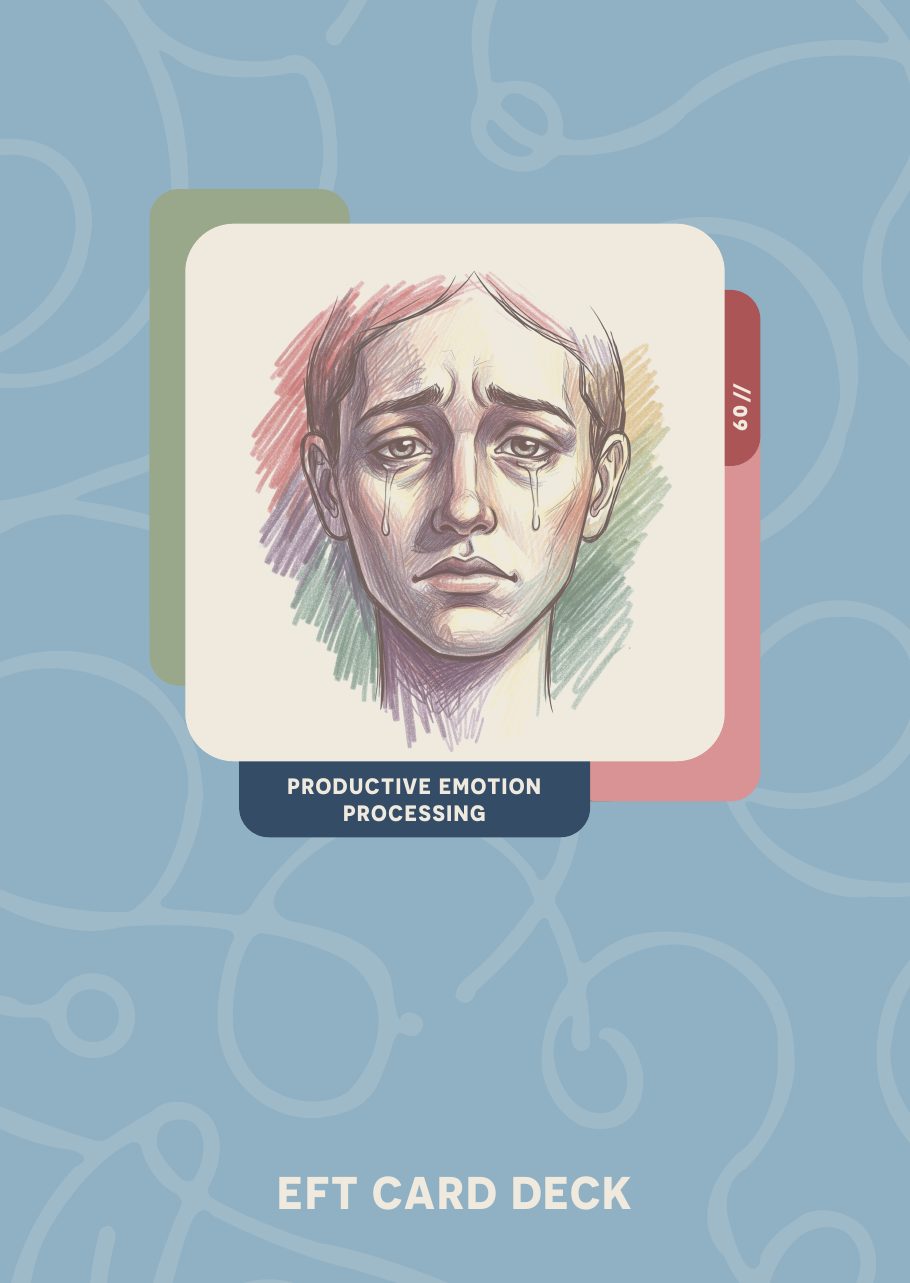
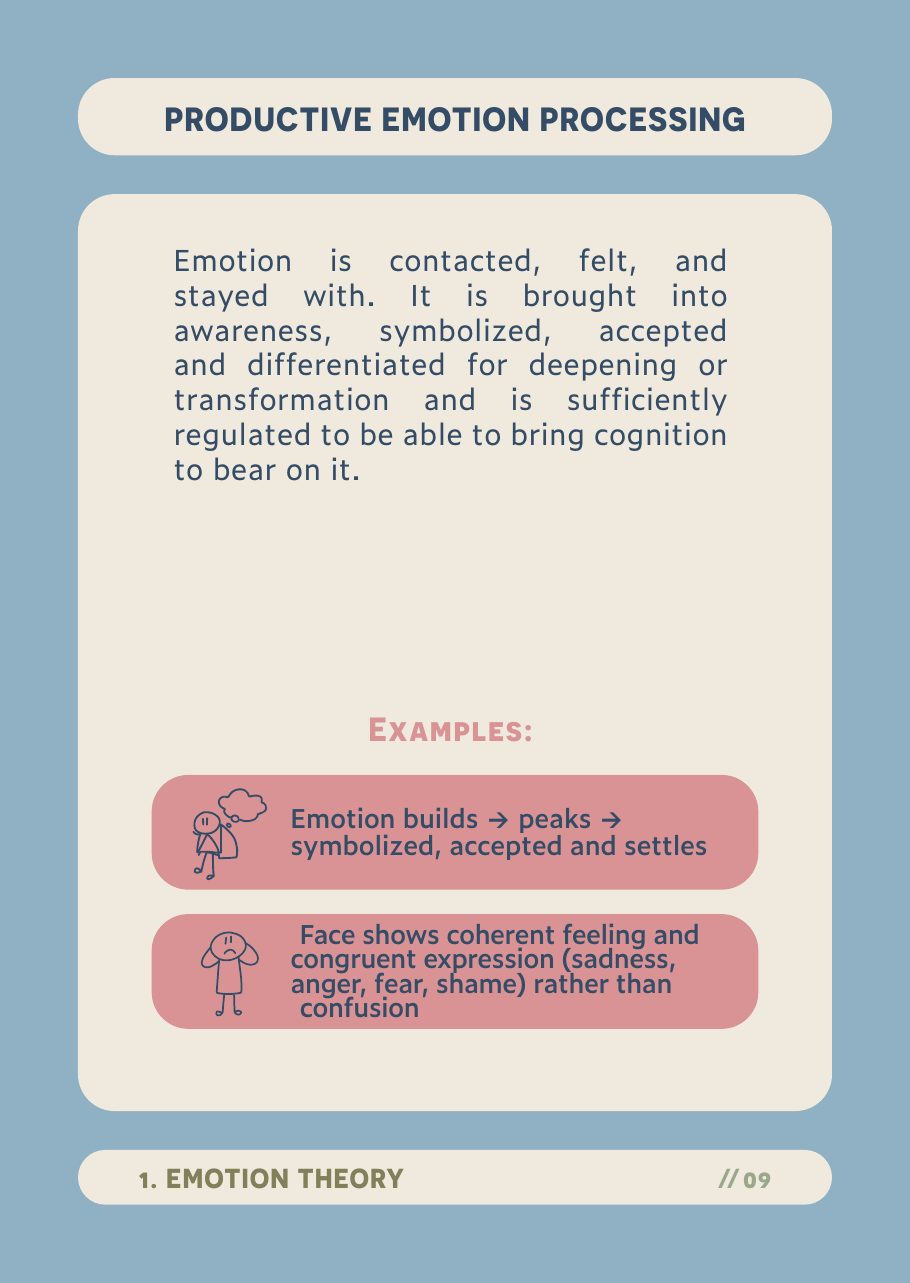
Card 09 of the EFT Clinical Process Card Deck defines productive emotion processing as:
"Emotion is contacted, felt, and stayed with. It is brought into awareness, symbolized, accepted and differentiated for deepening or transformation and is sufficiently regulated to be able to bring cognition to bear on it."
The card gives two examples of what this looks like:
- →Emotion builds, peaks, is symbolised and accepted, and settles.
- →The face shows coherent feeling and congruent expression (sadness, anger, fear, shame) rather than confusion.
Put simply, productive emotional processing is emotion that is both felt and worked with. The client is in contact with the feeling, not talking about it from a distance. And the client is not swamped by it either. There is enough steadiness to notice the feeling, put it into words, make sense of it, and let it develop into something new.
In Leslie Greenberg's emotion focused therapy, this is the condition under which emotion can change. Emotion that is avoided cannot be transformed. Emotion that floods the client cannot be reflected on. Productive processing sits between these two.
Why Feeling an Emotion Is Not Enough
A common misunderstanding of experiential therapy is that the goal is catharsis: get the feeling out and the client will feel better. Psychotherapy research in EFT points somewhere more precise.
Missirlian and colleagues (2005) found that in experiential therapy for depression, it was the combination of emotional arousal and reflective processing that best predicted good outcome, more than either one alone. Carryer and Greenberg (2010) found that a moderate frequency of highly aroused emotional expression was associated with better outcome, while both too little and too much were associated with poorer outcome.
The most direct test came from Auszra, Greenberg and Herrmann (2013), who developed a way to rate client emotional productivity in session. They found that how productively clients processed their emotions during the working phase of therapy predicted outcome, and did so better than emotional arousal on its own.
In other words, intensity is not the point. What matters is what the client is able to do with the emotion once it is present. As Greenberg often puts it, clients need to arrive at an emotion before they can leave it. Productive processing is what makes the leaving possible.
The Seven Features of Productive Emotional Processing
Auszra and colleagues described productive processing as primary emotion that is activated and processed with a particular quality of awareness. They identified seven features. Each one is worth knowing, because each one can be the place where processing gets stuck.
- Attending. The client's attention is on the emotion itself, not on the story around it or on the therapist's reaction.
- Symbolisation. The client puts the felt experience into words or images that fit. "Hurt" becomes "hurt that I was the one who always had to be the adult."
- Congruence. What the client says matches how they say it. The voice, face and body carry the same emotion as the words.
- Acceptance. The client allows the emotion rather than fighting, judging or apologising for it.
- Regulation. The client is close enough to feel the emotion and steady enough to reflect on it. Not shut down, not overwhelmed.
- Agency. The client owns the experience as their own. "I feel scared" rather than "it just comes over me" or "he makes me feel".
- Differentiation. The emotion opens out and develops. New meanings, nuances and feelings emerge, rather than the same statement being repeated.
Note the first condition: the emotion must be primary. Productive processing of a secondary emotion, such as hopeless collapse covering grief or reactive anger covering hurt, is limited. The emotion has to be the one that sits at the core of the problem (see Card 04: Secondary Emotion).
What Unproductive Emotional Processing Looks Like
Unproductive processing is not a failure on the client's part, and it is not a sign that therapy is going badly. It is often where clients start, because the ways they learned to manage painful emotion were once necessary. It is useful to know the common forms:
| Pattern | What it looks like | What is missing |
|---|---|---|
| Talking about | Fluent, detailed accounts of feelings with no felt contact | Attending, activation |
| Avoiding or interrupting | Changing the subject, laughing, "anyway", reaching for a tissue to stop the tears | Acceptance, staying with |
| Overwhelm | Emotion floods the client; they cannot think, speak or hear the therapist | Regulation |
| Repetitive distress | The same tearful complaint each week, without development | Differentiation, symbolisation |
| Incongruence | Smiling while describing something painful; words and face do not match | Congruence |
| Disowned emotion | "It just happens to me", "you'd feel that too" | Agency |
| Secondary emotion | Hopelessness, rejecting anger, or global distress that covers a more vulnerable feeling | Contact with primary emotion |
The first client in the opening vignette is caught in repetitive distress. Her tears are real, but they come with a secondary, hopeless "nothing ever changes". The primary emotion underneath, perhaps loneliness or fear of being left, has not yet been contacted.
Three Clinical Examples
The following are composite illustrations, not real clients.
1. From overwhelm to regulated contact
A woman describing a recent panic attack becomes flooded in session. Her breathing quickens and her words become fragmented. The therapist does not push deeper. She slows her own voice, invites the client to feel her feet on the floor, and reflects: "It's a lot. Let's go slowly. Something very frightening is here."
As the client steadies, she can say: "I'm scared I'll be alone when it happens." The emotion is still present, but now it can be named. Regulation has made processing possible. Fear of abandonment, rather than the panic itself, becomes the focus of the work.
2. From talking about to feeling
A man in his thirties gives a clear, articulate account of his mother's criticism. "I understand now that she was projecting her own insecurity." The insight is accurate and nothing moves.
The therapist asks him to slow down and notice what happens inside as he remembers one specific moment: being told his school report was "embarrassing". He pauses. His throat tightens. "I feel small. Like I want to disappear." He has moved from explaining shame to feeling it. Now, for the first time, the shame is available to be worked with (see When Insight Blocks Emotional Transformation).
3. The wave: builds, peaks, settles
In unfinished business work, a client addresses her late brother in the empty chair. Sadness builds as she speaks about the years they lost to a family conflict. She weeps fully. The therapist stays close and quiet. At the peak, she says: "I miss you. I wanted you back."
The sadness crests and begins to ease. Her breathing slows. She says, more softly, "I think I can let you be gone now." This is the shape the card describes: emotion builds, peaks, is symbolised and accepted, and settles. Grief has been completed rather than repeated.
How to Recognise Productive Processing in the Room
Productive processing is something you see and hear, not only something the client reports. Look for:
- →A wave shape. The emotion rises, reaches a peak, and then settles, often followed by a quieter, clearer statement.
- →A coherent face. The expression shows one recognisable emotion (sadness, anger, fear, shame) rather than confusion, mixed signals or a fixed smile.
- →A slower, more inward voice. Laura Rice's work on client vocal quality, a foundation of EFT, calls this a focused voice: the client is speaking from inside the experience.
- →Words that fit. The client tries a word, checks it, refines it. "Angry... no, more like betrayed."
- →Something new. A new meaning, need or feeling arrives that was not there at the start of the session.
- →Settling afterwards. The client feels lighter, clearer or more grounded, not depleted.
And the opposite signals: fast or rehearsed speech, the same phrases each week, emotion that escalates without settling, or a client who seems far away from what they are describing.
How EFT Therapists Support Productive Processing
Helping a client move into productive processing is delicate work. It requires judging, moment to moment, whether the client needs to come closer to the emotion or step back from it. This difficulty is inherent to the work itself, and even very experienced therapists spend much of their attention here.
Some guiding principles:
Help the client approach. When the client is talking about rather than feeling, slow down, focus on one specific moment, and invite attention inward. "What happens inside as you say that?"
Help the client regulate. When emotion floods, offer steadiness before depth. Slow your voice, ground the client in the present, and provide the safety of an empathic presence. The aim is the right distance from the emotion, not the absence of it.
Help the client symbolise. Offer tentative empathic reflections and conjectures that the client can check against their felt sense. The client's response tells you whether the words fit.
Help the client accept. When clients apologise for or judge their emotions, validate the emotion as understandable and meaningful. Acceptance is often what allows the emotion to complete its wave.
Help the client own. Gently shift disowned language toward first-person experience. "So right now, you feel..."
Help the emotion differentiate. Once a primary emotion is present and steady, follow its edges. What is the hurt about? What does it need? This is where processing moves toward needs and, from there, toward new emotion.
Keep the primary emotion in focus. If the client is processing a secondary emotion well, it may still not lead to change. Use what you see to sense what lies beneath (see How EFT Therapists Choose Which Emotion to Work With First).
Productive Processing and the Card Series
Card 09 brings several earlier cards together:
- →Card 02: Core Pain and Card 03: Primary Maladaptive Emotion describe what needs to be reached. Productive processing describes how it needs to be held once it is reached.
- →Card 06: Needs becomes accessible when primary emotion is processed productively. Needs rarely surface from overwhelm or from intellectual distance.
- →Card 07: Emerging Adaptive Emotion and Card 01: Transformation by Synthesis describe what can happen next: a new emotion arises and changes the old one. That process depends on the old emotion being present, felt and steady enough to be met.
- →Card 08: Self-Organising Process describes the larger system that productive processing reorganises.
Seen this way, productive emotional processing is the hinge on which much of the change process in emotion focused therapy turns.
Frequently Asked Questions
What is emotional processing in therapy?
Emotional processing in therapy is the way a client becomes aware of, experiences, makes sense of, and works through an emotion during a session. In emotion focused therapy, processing is considered productive when a primary emotion is felt, put into words, accepted, and held steadily enough that it can be reflected on and can change.
Is crying in therapy always productive?
No. Crying can be part of productive processing, but it can also be a secondary or repetitive form of distress that does not lead to change. What matters is whether the emotion is primary, whether the client can stay with it and make sense of it, and whether something new emerges.
Can you process an emotion without feeling it?
Not in the sense EFT means. Understanding an emotion intellectually can be helpful, but research in experiential therapy suggests that change is most strongly associated with emotion that is both activated and reflected on. Insight without felt contact tends to leave the emotion unchanged.
What should a therapist do if a client becomes overwhelmed?
Prioritise regulation before depth. Slow down, ground the client in the present, and offer a steady empathic presence. Once the client can feel the emotion without being flooded by it, processing can continue.
How is productive emotional processing measured in research?
Researchers in emotion focused therapy have used the Client Emotional Productivity Scale, developed by Auszra, Greenberg and Herrmann, which rates whether an activated primary emotion is processed with features such as attending, symbolisation, congruence, acceptance, regulation, agency and differentiation.
Key Takeaways
- →Productive emotional processing means emotion is contacted, felt, stayed with, put into words, accepted, and regulated enough to reflect on.
- →Emotional intensity alone does not predict change. What the client does with the emotion does.
- →Seven features mark productive processing: attending, symbolisation, congruence, acceptance, regulation, agency, and differentiation.
- →The emotion being processed needs to be primary. Processing a secondary emotion well rarely leads to transformation.
- →Unproductive patterns such as overwhelm, talking about, or repetitive distress are common starting points, not failures.
- →Productive processing is the gateway to accessing needs and to the emergence of new adaptive emotion.
Using Card 09 Outside the Room
Card 09 sits in the Emotion Theory section of the EFT Clinical Process Card Deck. Like the rest of the deck, it is designed for reflection outside the session, where your attention can go to the card instead of the client. After a session, use it to review a moment of emotion: was it productive, and if not, which of the seven features was missing? In supervision, it gives a shared language for describing what happened when emotion arose but nothing moved.
References
- →Auszra, L., Greenberg, L. S., & Herrmann, I. (2013). Client emotional productivity: Optimal client in-session emotional processing in experiential therapy. Psychotherapy Research, 23(6), 732–746.
- →Carryer, J. R., & Greenberg, L. S. (2010). Optimal levels of emotional arousal in experiential therapy of depression. Journal of Consulting and Clinical Psychology, 78(2), 190–199.
- →Greenberg, L. S. (2015). Emotion-Focused Therapy: Coaching Clients to Work Through Their Feelings (2nd ed.). American Psychological Association.
- →Missirlian, T. M., Toukmanian, S. G., Warwar, S. H., & Greenberg, L. S. (2005). Emotional arousal, client perceptual processing, and the working alliance in experiential psychotherapy for depression. Journal of Consulting and Clinical Psychology, 73(5), 861–871.
Related clinical articles
- →Emotion Focused Therapy: The Guide
- →Card 06: Needs in Emotion Focused Therapy
- →Card 07: Emerging Adaptive Emotion
- →Card 08: Self-Organising Process in EFT
- →Card 04: Secondary Emotion in EFT
- →When Insight Blocks Emotional Transformation
- →Does Emotion Focused Therapy Really Work?
About the Author
Aaron Lerch
Clinical Psychologist · Certified EFT Supervisor and Trainer, ISEFT Level D
Aaron is the founder of EFTSkills. His clinical and teaching work focuses on helping therapists apply Emotion Focused Therapy with greater precision in real sessions — including marker recognition, emotional process tracking, chair work, core pain, and task selection.